
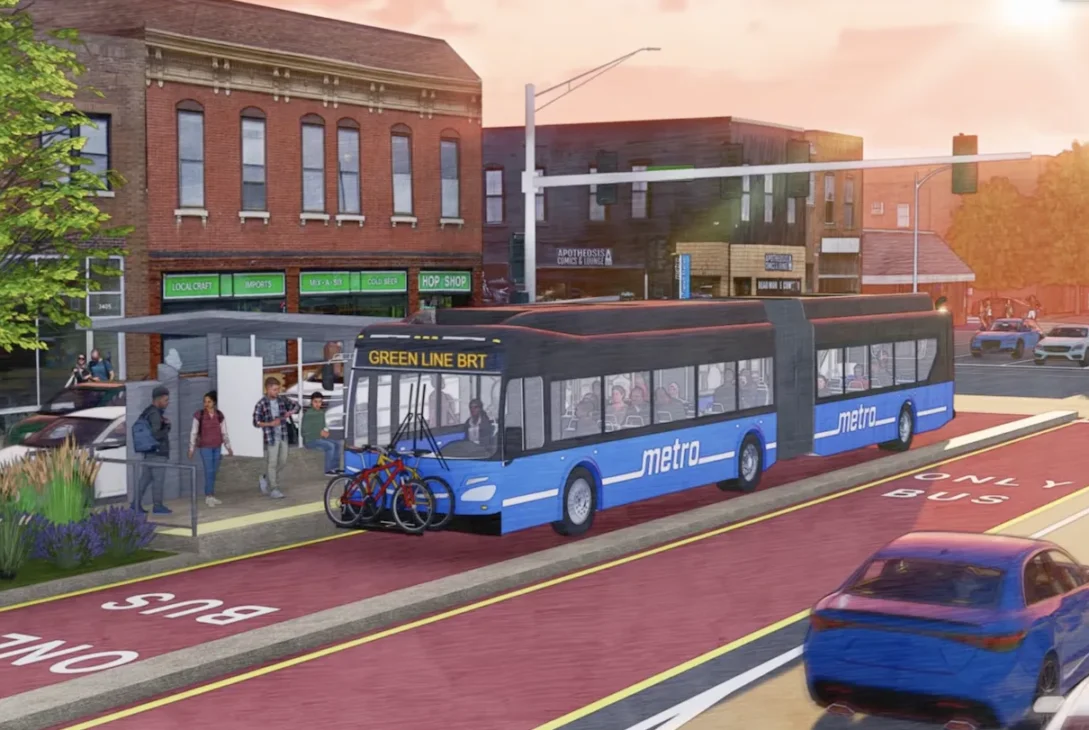
St. Louis Mayor Cara Spencer is presenting the city’s final route plan for a north-south Bus Rapid Transit line to the East-West Gateway Council of Governments this morning, bringing the project closer to reality.
Securing regional council approval is a critical milestone for obtaining federal funding, according to Scott Ogilvie, the city’s planning executive. He notes that the Federal Transit Agency is expected to cover approximately half the project’s cost, with total estimates ranging from $360 million to $590 million.
Get a fresh take on the day’s top news
We will never send spam or annoying emails. Unsubscribe anytime.
Voters approved a new tax in 2017 to fund the Green Line, a third MetroLink line running north and south. The tax has generated approximately $110 million to date, but constructing even a basic light rail line would require an estimated $1.1 billion. This budget gap led the city to explore bus rapid transit as an alternative.
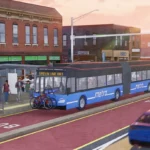
Spencer emphasizes that “bus rapid transit is the way of the future,” highlighting its affordability and route adaptability. Bus rapid transit operates as a hybrid between traditional buses and trains, featuring dedicated lanes, elevated stations, and traffic signal priority to ensure faster service.
Spencer’s presentation at today’s East West Gateway Council of Governments meeting will outline the selected route, which begins at Meramec and South Broadway near Minnie Wood Park in Dutchtown. The line extends north to Jefferson with stops at Chippewa, Gravois, Arsenal, and Park Avenue. From there, it travels east on Chouteau and north on 18th Street before reaching downtown via Tucker Boulevard. The northern section runs along Florissant to Jefferson and Natural Bridge, featuring eight stops along Natural Bridge before terminating at Goodfellow. The council will vote following Spencer’s presentation.
According to Ogilvie, “passenger traffic will flow from the endpoints into the center, reaching downtown.”
The chosen route was selected from two finalists. The alternative proposal featured significantly fewer downtown stops and followed Jefferson Avenue for much of its path rather than Tucker. Spencer explains, “I believe that alternative would have missed an opportunity to provide more direct connections to downtown.”
While Ogilvie confirms both routes were viable, the selected option better reflects existing transportation patterns and proximity to affordable housing, which typically attracts more riders. Additionally, the BRT line extends further than the originally proposed light rail and reaches the county line on its northern end, potentially enabling coordinated county development. Ogilvie states, “Looking ahead, that represents the region’s core long-term vision.”
Over the next year, the city will refine cost estimates as preliminary engineering begins, determining curb modifications, bus specifications, and station designs. Assuming favorable conditions, the BRT line could become operational by 2031.
The $110 million accumulated from the 2017 tax remains disputed. Spencer contends the funds can transition to bus rapid transit without additional approval. However, some city officials, including Aldermanic President Megan Green, argue that voters should explicitly authorize redirecting the money from light rail to BRT through another referendum. A representative for Green indicated no current timeline exists for placing the question before voters.