
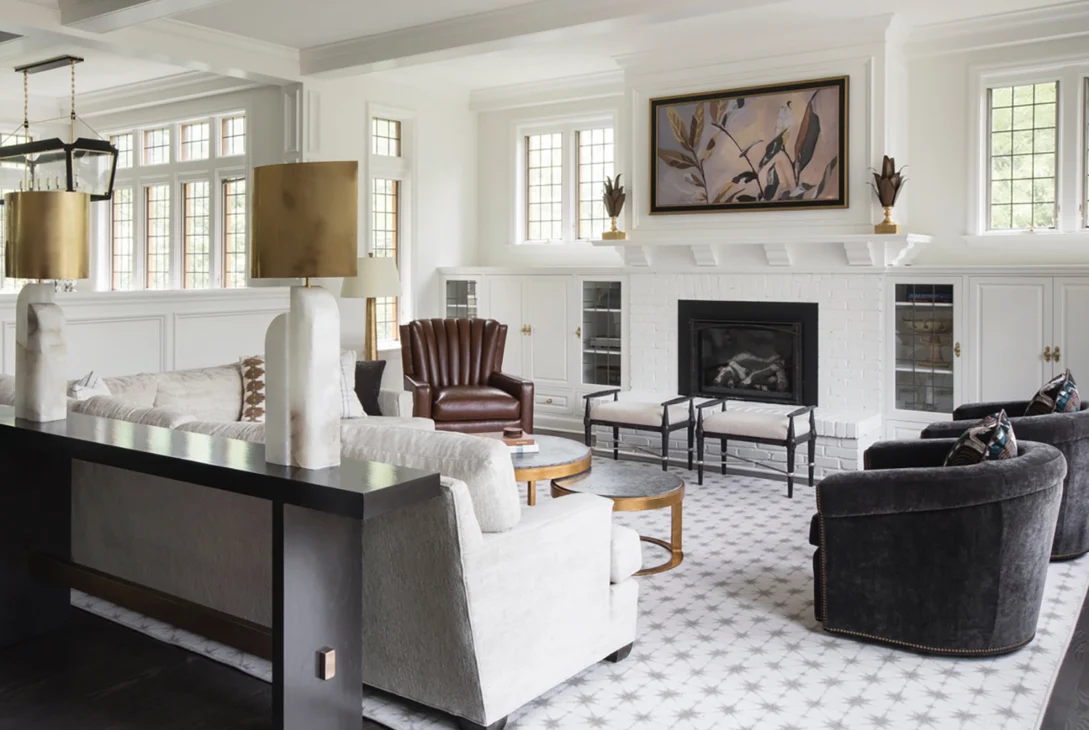
Open floor plans have become increasingly popular beyond modern homes and new construction—they’re now appealing to those who love historic properties as well. “While most people appreciate historic architecture and the intricate details and quality craftsmanship it showcases, their lifestyle needs have changed,” explains Randy Renner, owner of Period Restoration. “Unlike residents from 100 years ago, today’s homeowners want to entertain and live actively in these spaces.”
Many homeowners find themselves restricted by their kitchens, which were originally designed as separate, functional spaces hidden from view. Modern kitchens have evolved into central gathering areas where people prefer to spend time, regardless of the appeal of other rooms in the house.
Get a weekly dose of home and style inspiration
We will never send spam or annoying emails. Unsubscribe anytime.
Interior designer Ellen Lancia of Design Collective Saint Louis reports that roughly ninety percent of her clients request a larger kitchen to accommodate family and friends and enable better interaction between guests and hosts. “Historic homes weren’t originally designed as gathering spaces like they are today,” she notes. “There’s something charming about them, but homeowners often realize they don’t feel as connected to each other as they’d hoped.”
According to Renner, “nearly everyone” he works with wants to open up spaces and reduce walls between rooms. While kitchen renovations top most clients’ wish lists, second-floor modifications—where multiple bedrooms and bathrooms can be merged into one expansive suite—are growing in popularity. Larger homes naturally provide more flexibility for reconfiguration, while smaller homes with heavily divided rooms require more extensive wall removal to achieve the desired layout. “Smaller houses often require more invasive changes because you’re working with limited square footage,” Renner explains.
The advantages of modernizing a historic home span both appearance and usability. Before proceeding, evaluate traffic patterns, sight lines, and how to preserve architectural character through details like plaster crown molding or decorative door frames. “You need to examine what’s happening in each connected room,” says Taylor Huston, an architect at Kirkwood-based Agape Construction. “If your dining room has ornate molding but your kitchen has none because it was originally utilitarian, you’ll need to decide whether to remove it entirely or invest in extending it throughout,” she explains. “In larger homes, I encourage clients to maintain or even enhance their trim in connected spaces to create visual impact while improving function. Crown molding flowing through both areas increases the overall effect.” Lancia emphasizes the importance of restraint when editing a historic home’s architecture, since its original character is likely what attracted the homeowner initially.
Budget is naturally important, but assembling the right professionals is equally critical. Your team should include an architect, structural engineer, contractor, and interior designer. While it might seem straightforward to hire a contractor to remove a wall, “Without a designer or professional perspective, they may overlook important considerations like sight lines,” cautions Lancia. “I’ve witnessed people remove walls only to discover they’ve created an undesirable view of the side yard.”
Huston has encountered properties where interior walls were stripped out by flippers or contractors hoping to attract future buyers. “This often results in a narrow, elongated hallway-like room—sometimes 12 feet wide and 35 feet long—which most people dislike due to the echoing effect,” she notes. Preserving some wall separation not only reduces noise but maintains visual boundaries that honor the home’s historic character. “Opening a 12-foot-wide room to 9 or 10 feet creates an open feel without becoming an empty corridor,” she continues. “This gives you more furniture arrangement options and better flow while maintaining the home’s integrity.”
Historic homes demand specialized knowledge due to their construction diversity. “Joists might run one direction on the first floor and another on the second, which can be puzzling,” Lancia explains. Additionally, outdated knob-and-tube wiring must be addressed. Modern construction is more predictable, making load-bearing walls easier to identify. Still, surprises can hide inside walls, so it’s wise to investigate before demolition begins. “We always identify structural and non-structural elements beforehand by examining joists and the building’s engineering,” says Huston. “However, you occasionally discover something unexpected during the work—perhaps a hidden chimney, plumbing, or main radiator pipes—and you have to adapt accordingly.”
Sometimes simply enlarging an opening from three or four feet achieves a modern aesthetic. Most homeowners choose a balanced approach. “They want improvements that allow large furniture to move through easily and improve views, but don’t necessarily want completely open spaces,” Huston explains.
“When you make thoughtful changes that preserve what made the home worth restoring, the value increase can be substantial,” concludes Lancia.