

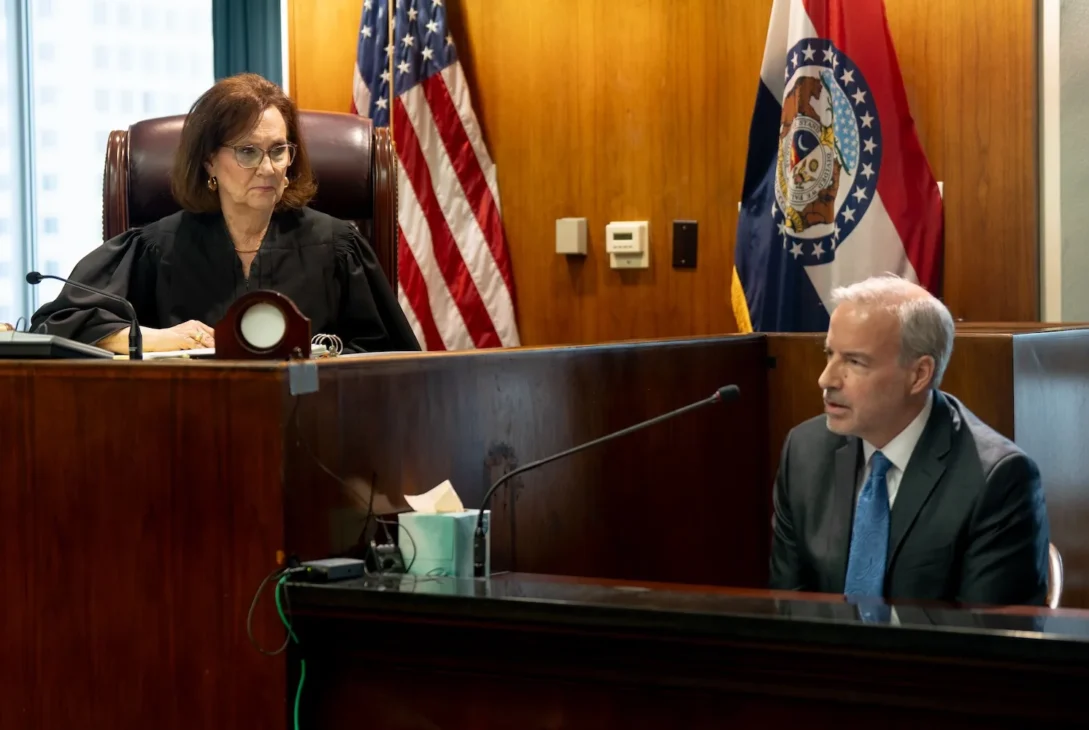
The St. Louis Police Board’s lawsuit hinges on a critical question: what counts as “revenue”? The board is seeking a court order requiring the city to allocate an additional $67 million to the police department by June 30, arguing that the city failed to meet the state-mandated 22 percent spending requirement for fiscal year 2026. The dispute centers on whether settlement funds from the Rams and city reserves should be counted as general revenue. The city allocated $189 million to police this year, but the board contends the figure should be approximately $257 million.
During the initial hearing before Judge Joan Moriarty earlier this week, both sides presented starkly different interpretations of state law. The Police Board’s attorney characterized the case as straightforward, citing a Missouri Supreme Court definition of general revenue as “all current income of the city, however derived, which is subject to appropriation for general public uses.” However, the city’s legal team countered that neither Missouri law nor standard accounting practices classify settlement funds and reserves as revenue in subsequent years.
Get a fresh take on the day’s top news
We will never send spam or annoying emails. Unsubscribe anytime.
City Budget Director Paul Payne provided detailed testimony explaining the city’s accounting position. He stated that settlement funds are treated as revenue only in the year they are received, not in subsequent fiscal years. When pressed by the Police Board’s attorney to identify specific legal authority for this interpretation, Payne acknowledged he could not cite any law but described it as standard accounting practice. Regarding reserve funds, Payne warned that dedicating 25 percent of reserves to police spending would deplete the city’s reserves below professionally recommended levels within two years.
The city strengthened its position by calling Peter Karutz, a certified public accountant and forensic expert, who testified that accounting standards define revenue as income earned or incurred during a specific period. Karutz stated that reserves and settlement funds do not qualify as revenue for fiscal year 2026. The Police Board’s attorney objected, arguing that accounting principles are irrelevant to interpreting state law.
Beyond the accounting dispute, the city raised a procedural challenge to the lawsuit itself. An assistant city counselor argued that the mandamus action fails because the Police Board never formally demanded the $67 million or requested the additional appropriation. He also highlighted the timing issue, noting that the demand came just six weeks before the fiscal year’s end. The Police Board’s attorney countered that the city’s Board of Estimate and Apportionment had blocked previous spending attempts.
Judge Moriarty is expected to issue a ruling within weeks, likely before June 30. Should the city lose, it may pursue an appeal, though legal experts suggest the accelerated timeline would require expedited proceedings given the fiscal year’s approaching end.
Notably, Moriarty recently ruled against the police department in a separate matter, ordering it to pay the Post-Dispatch $5,000 for withholding public records in violation of Missouri’s Sunshine Law.
Despite the technical nature of the arguments, the hearing included moments of humor. Moriarty joked about holding night court if necessary to complete witness testimony in a single day. The Police Board’s attorney also lightened the mood when he confused exhibit numbers, joking that “numbers aren’t my thing.”
Brendan Roediger, a St. Louis University Law School professor who observed the hearing, offered his assessment: “At least for today, it didn’t seem like Operation Defund St. Louis is likely to succeed. But going after the City’s reserves shows a level of greed I doubt even the governor predicted.”